
Last updated September 20, 2026
Level 1 sweep and inspection to the NFPA 211 annual standard - flue, crown, cap, and flashing checked and photographed
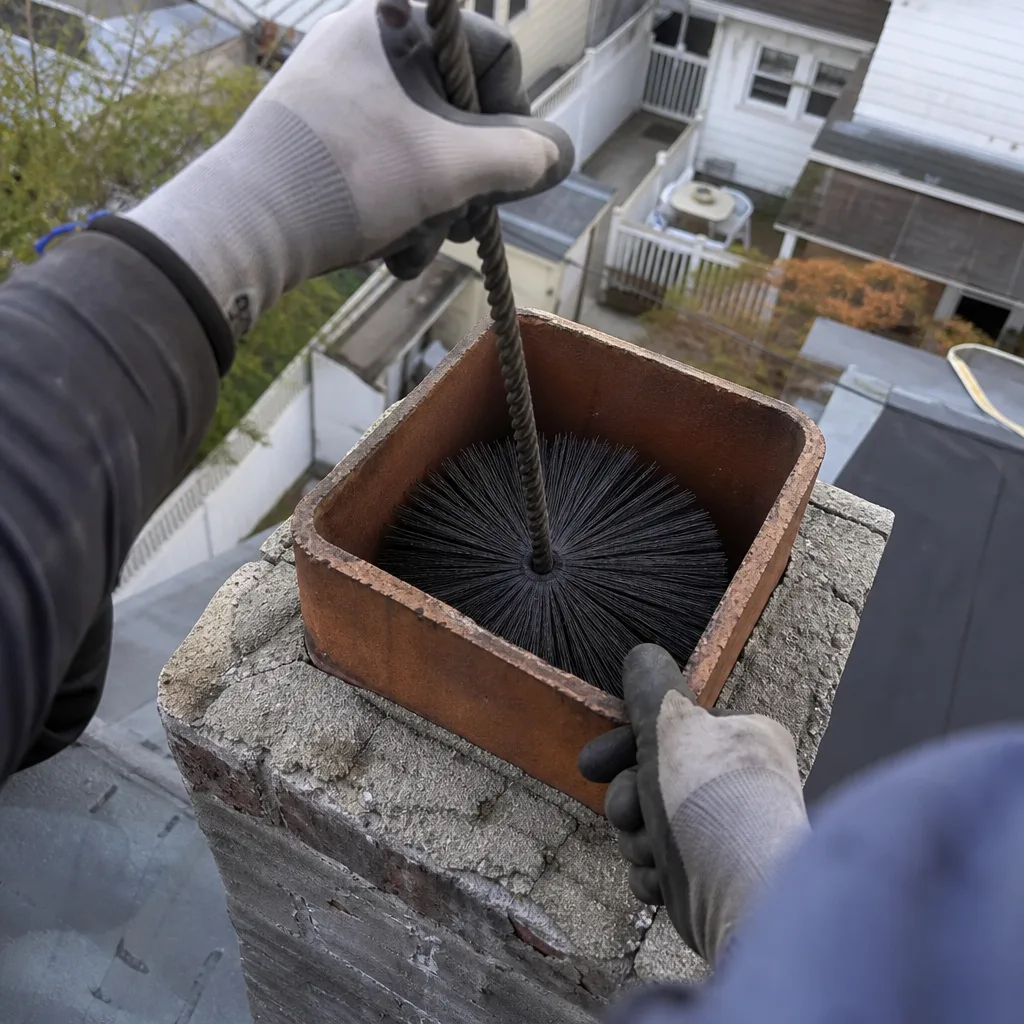
Chimney sweep logs do not sweep chimneys. They loosen some creosote - which then falls where a brush and vacuum still have to collect it.
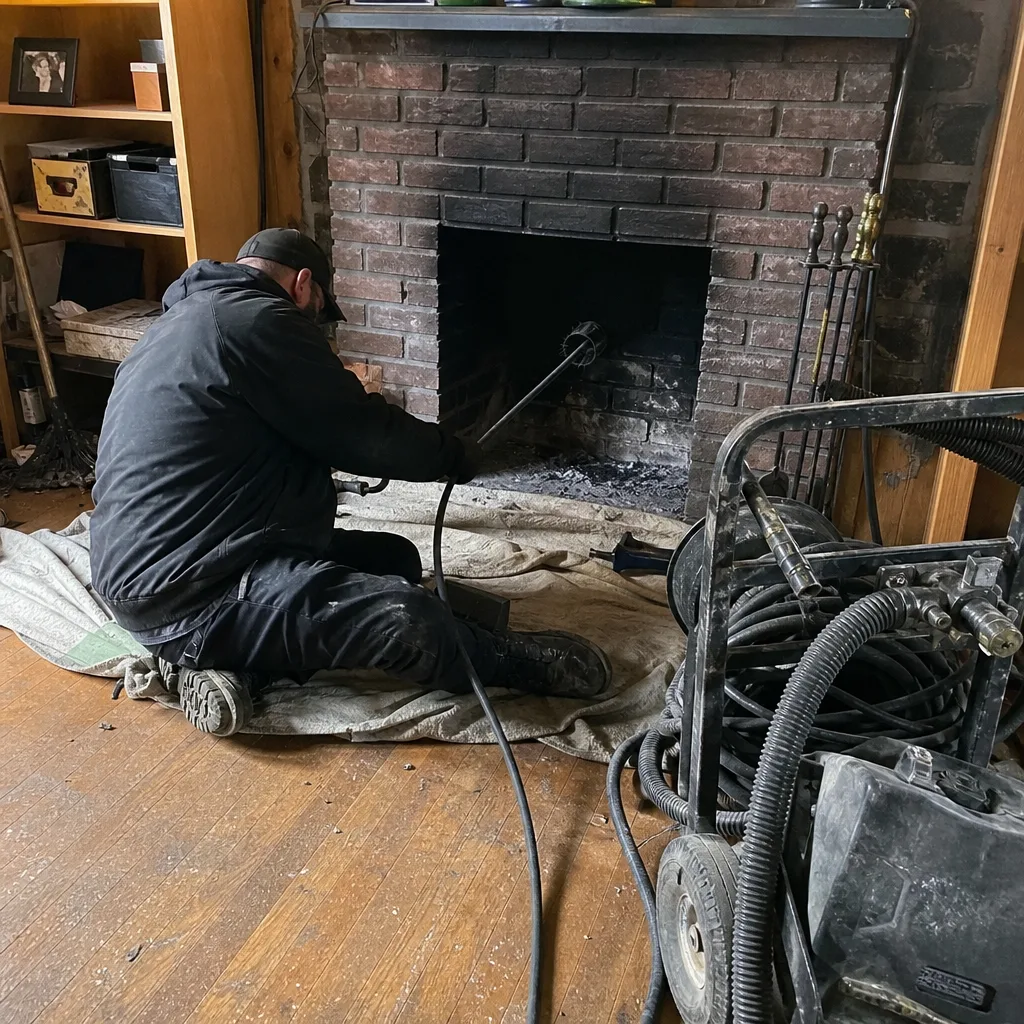 Before
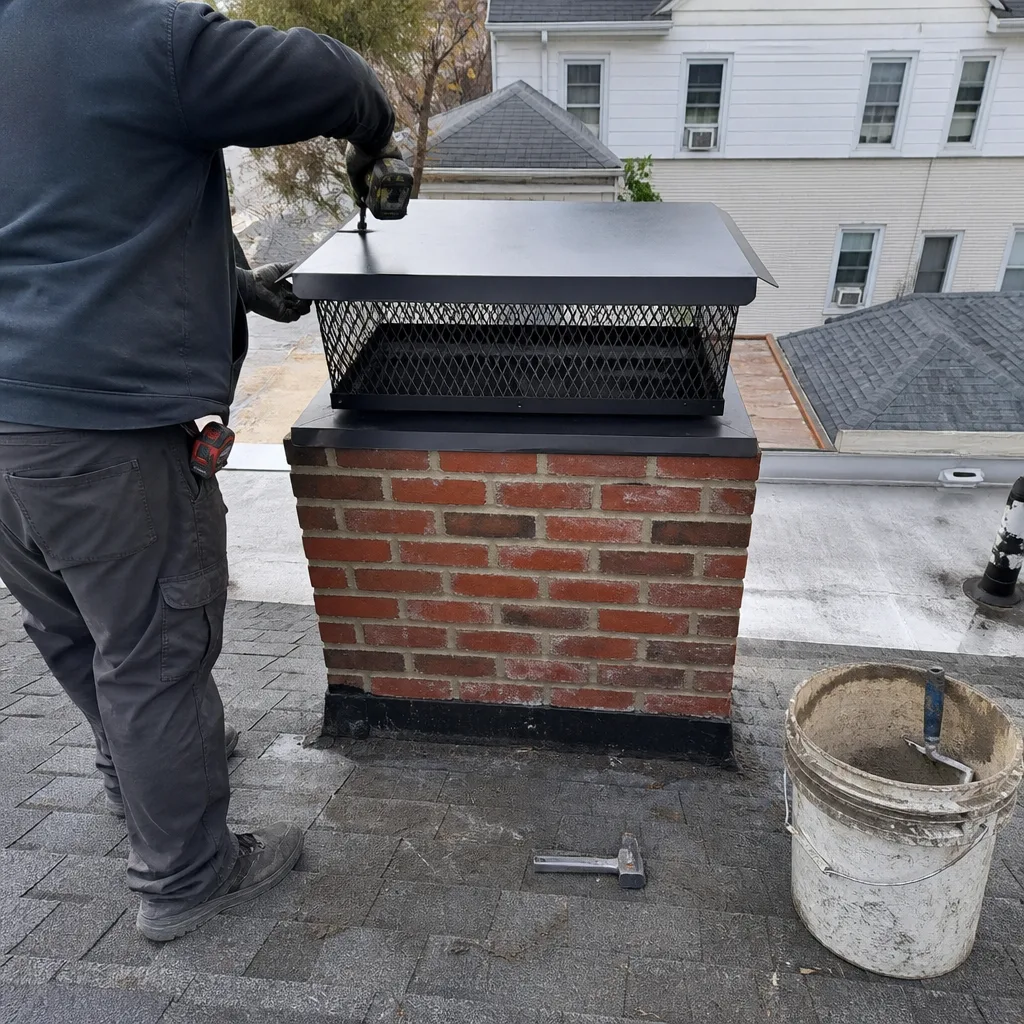 After
After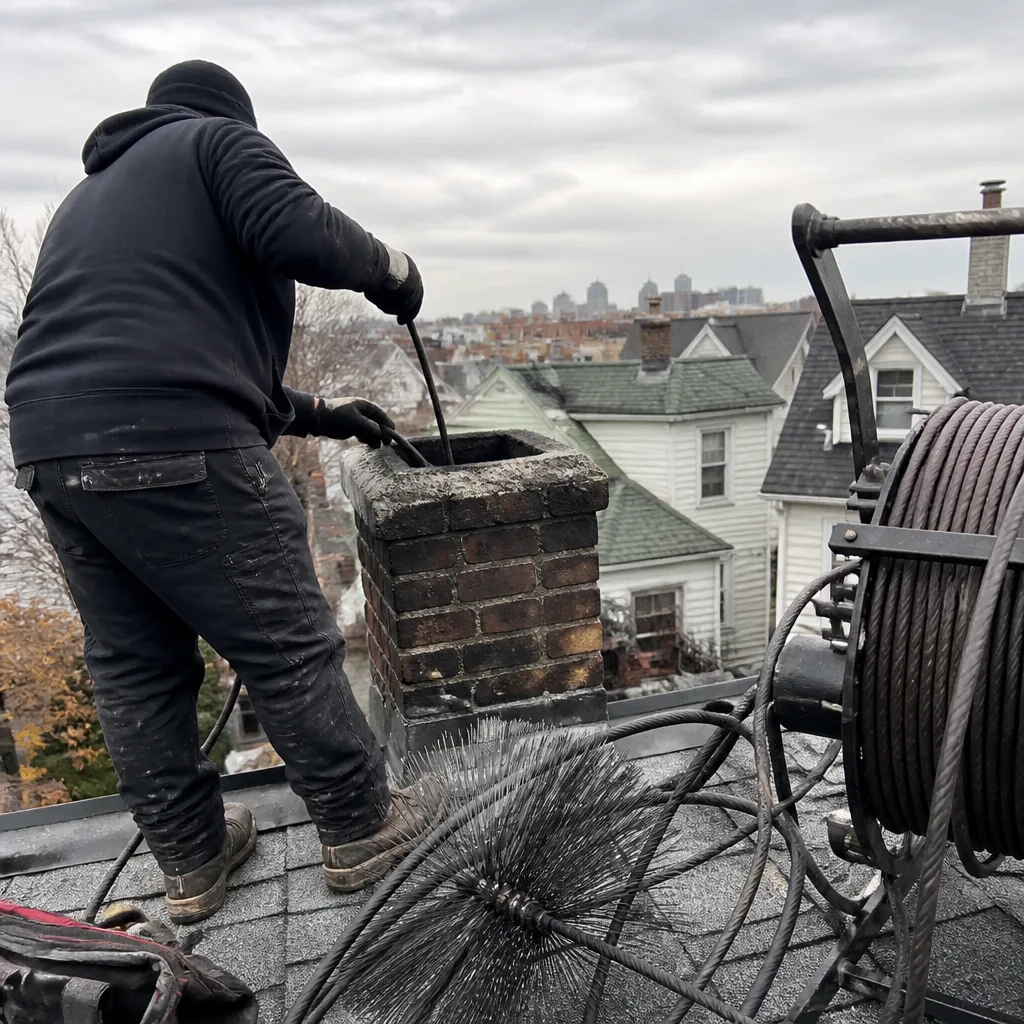 Before
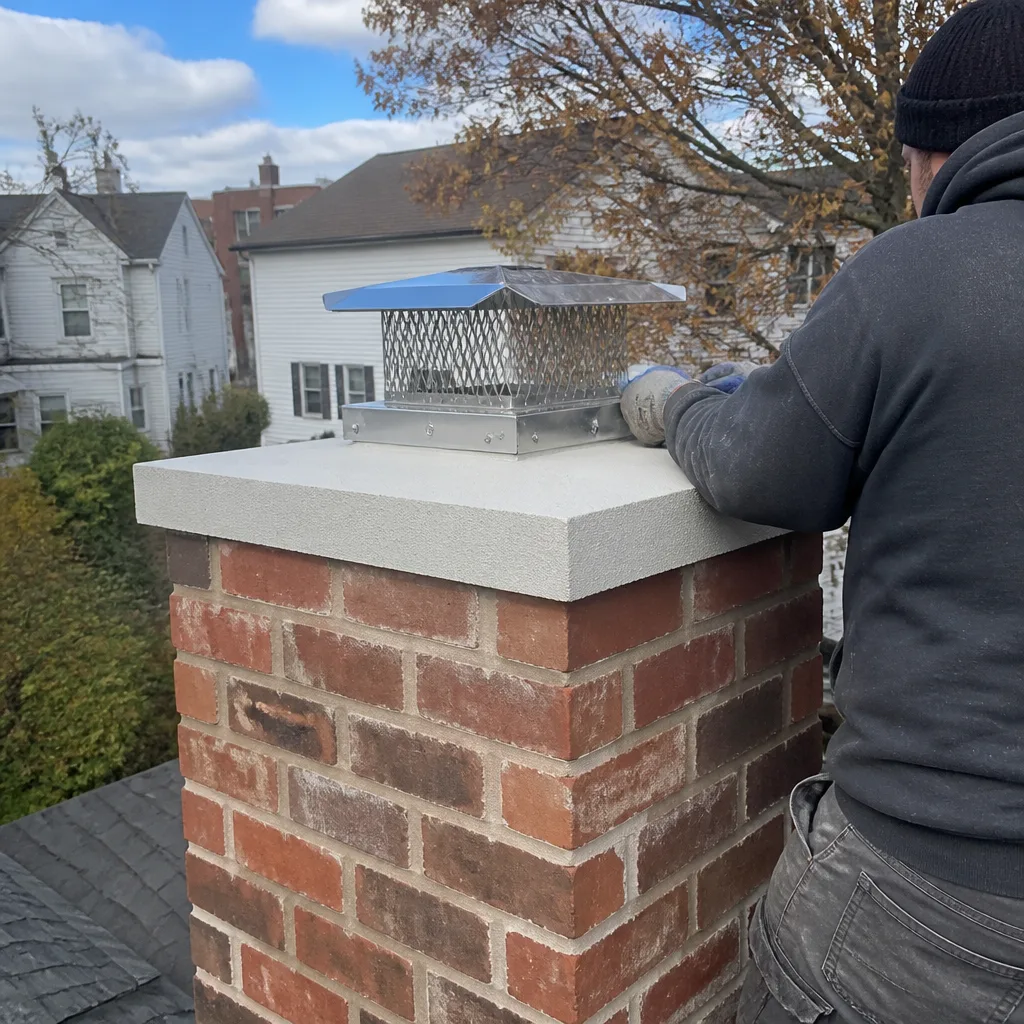 After
After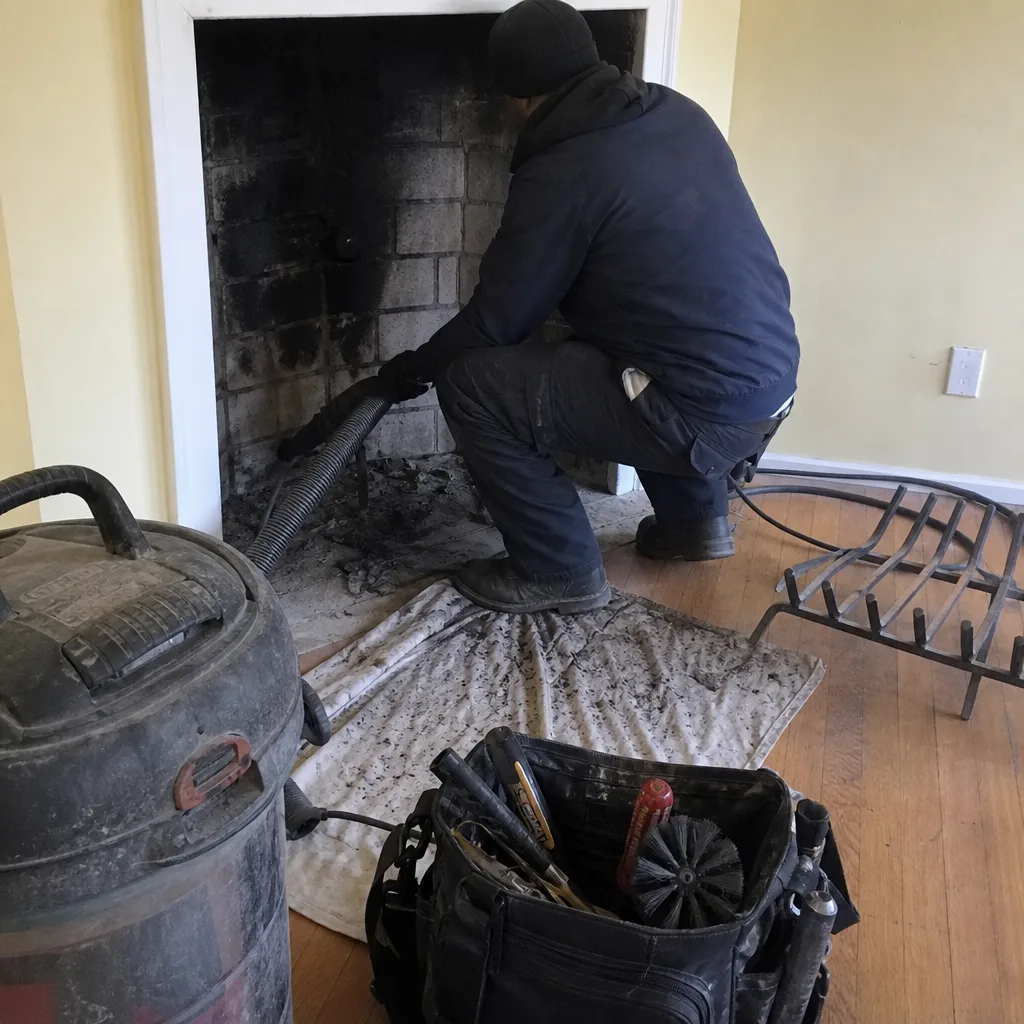 Before
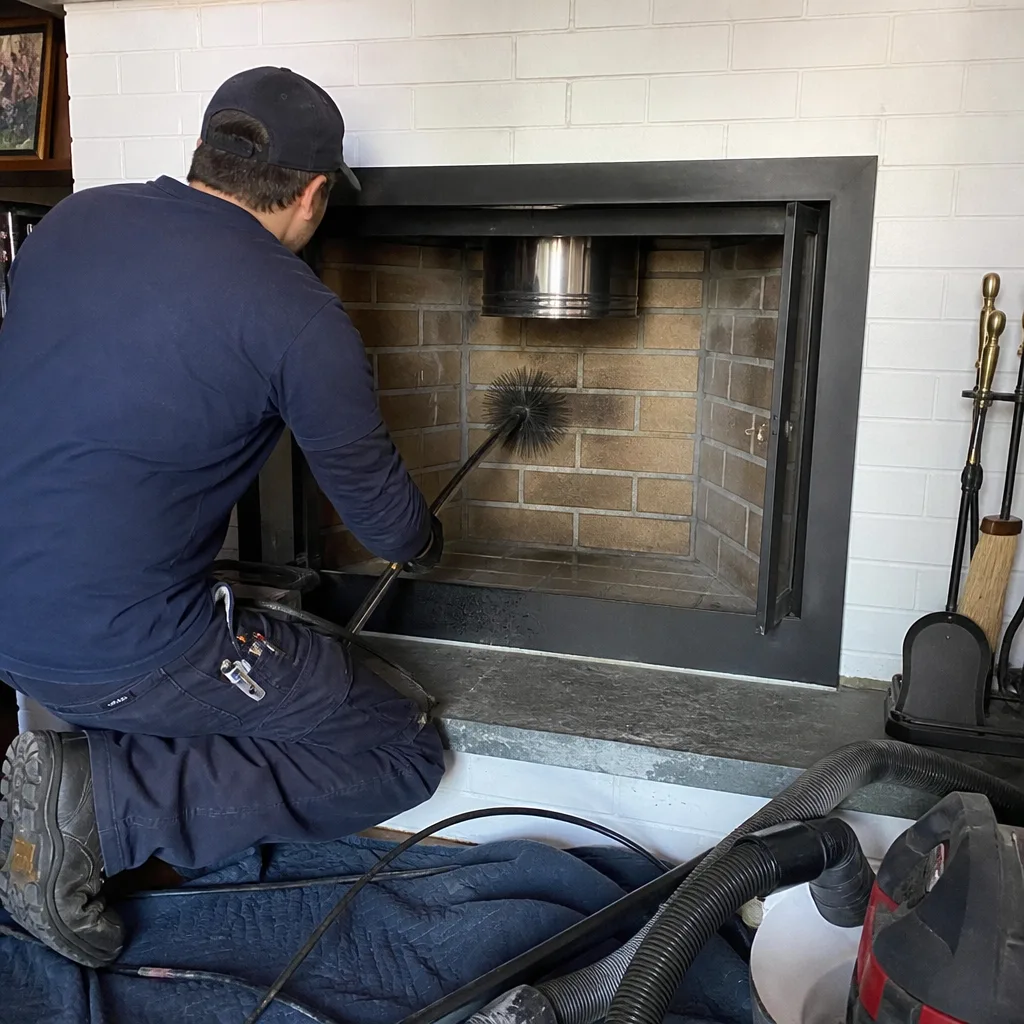 After
AfterChimney Cleaning Warning Signs: A Astoria Homeowner’s Reference Guide
In Astoria, the first fall fire in a fireplace often reveals what the previous spring’s last fire left behind. The National Fire Protection Association reports that chimneys, fireplaces, and vents are involved in roughly 25,000 residential fires each year in the United States, and the majority share a single cause: creosote accumulation that nobody saw because nobody looked. This guide will teach you to read the signs your chimney gives you, which ones mean “schedule a cleaning,” which ones mean “schedule an inspection before you light another fire,” and which ones mean a fire or carbon monoxide event is already trying to happen.
Quick Answer
The warning signs that matter fall into three urgency classes: cleaning-level signs (dark flaky buildup, mild smoke smell after a fire, slow draft), inspection-level signs (smoke smell in summer, white staining on exterior brick, unusual sounds inside the chimney, animal activity), and do-not-use signs (tar-like smell at the hearth, smoke entering the room, pilot instability on gas appliances, yellow burner flames). If you see anything in the last category, stop using the chimney and call for a camera-documented inspection before the next fire.
Table of Contents
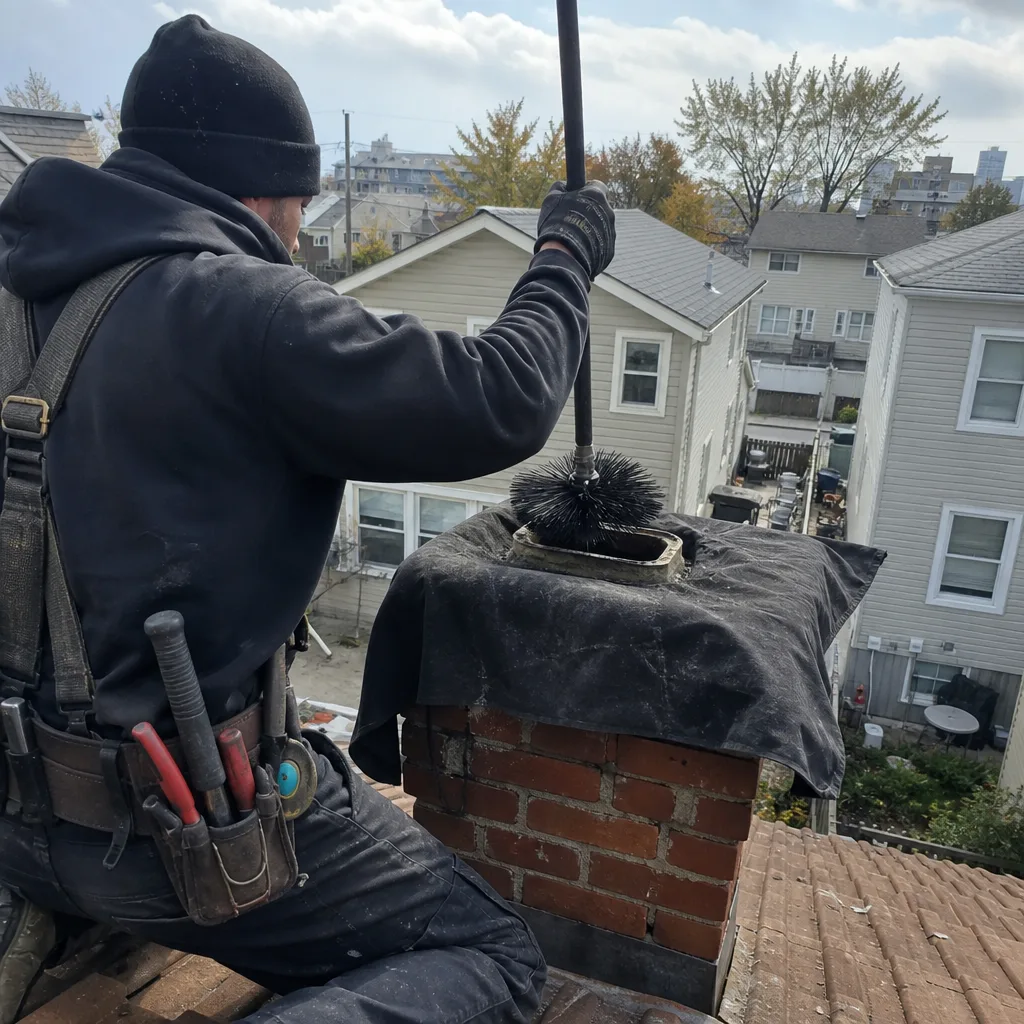
- Why Urgency Matters More Than the Sign Itself
- Summer Smoke Smell: The Sign That Looks Innocent
- Reading Creosote: What Color and Texture Tell You
- White Dust on Brick: An Astoria Rowhouse Signal
- Animal Debris at the Firebox: What It Means for Your Liner
- Gas Appliance Warning Signs Homeowners Blame on the Appliance
- Odd Sounds, Draft Changes, and the Damper You Never See
- Common Mistakes to Avoid
- When to Call a Professional
- Frequently Asked Questions
- The Bottom Line
 Before
 After
AfterWhy Urgency Matters More Than the Sign Itself
Every warning sign is a piece of evidence. The question is what it’s evidence of. A flaky, sooty buildup on the flue wall is evidence that a cleaning is overdue. Smoke pushing back into the living room is evidence the chimney cannot safely expel combustion gases right now. Both show up on the same chimney, often in the same season, and confusing one for the other is how houses burn.
We see this pattern regularly in Astoria’s housing stock. The brick rowhomes and semi-attached houses along Ditmars Boulevard, 30th Avenue, and Broadway were built with masonry chimneys that have been in service for 70 to 100 years. The tile liners inside those chimneys were never designed to handle decades of thermal cycling. When a liner fails, the first sign is often a smell or a stain that gets dismissed as “the house settling” or “the wind blowing the wrong way.” By the time smoke visibly enters the room, the liner may have been compromised for years, letting combustion gases move through wall cavities and chase spaces where no one can see them.
Here is the three-level urgency framework we will use throughout this guide:
- Schedule cleaning: The chimney is functioning but accumulating creosote faster than it’s being removed. You can keep using it while you wait for the appointment, assuming the buildup is not already at the upper threshold.
- Schedule inspection before next use: There is evidence of a structural or moisture problem, or the sign could indicate either a cleaning or a repair. Do not burn again until a camera scan clarifies what you are dealing with.
- Do not use – call today: The chimney is actively failing to contain or expel combustion byproducts. Every additional fire increases the probability of a chimney fire or carbon monoxide exposure.
In our experience in Astoria, most homeowners are accurate about placing signs in the first category and wrong about the second. The signs that look mild are often the ones indicating a deeper problem. The signs that feel alarming, like a strong campfire smell after a fire, are often just a cleaning issue. This guide exists to correct that inversion.
If you’re seeing any sign you cannot confidently place in the first category, the appropriate next step is a Chimney Cleaning & Sweep in Astoria that includes a Level 2 camera inspection, not a flashlight look up from the hearth. The camera is what tells you whether the white haze on your firebox wall is superficial or whether it’s moisture being pulled through a cracked liner.
Summer Smoke Smell: The Sign That Looks Innocent
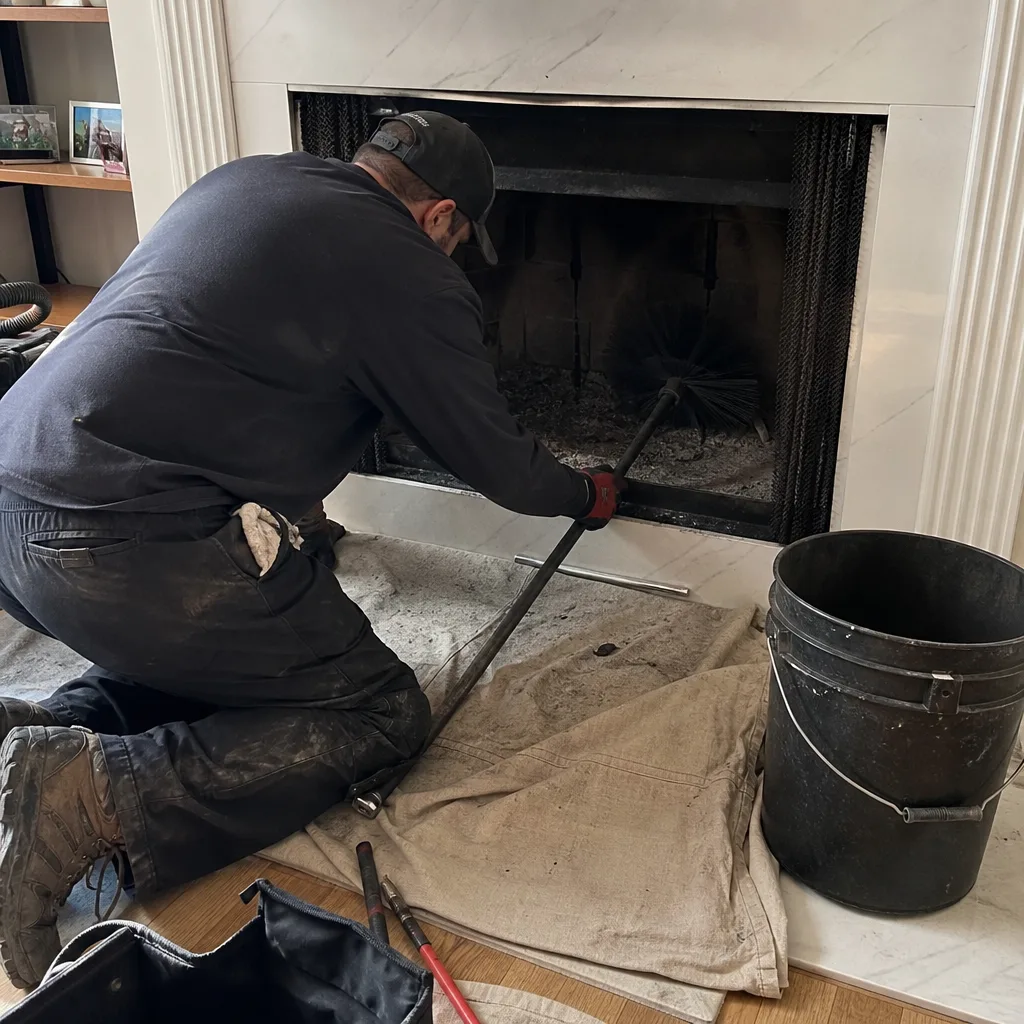
A smoke smell in July is the most commonly dismissed chimney warning sign in Astoria, and the dismissal is usually reasonable. Chimneys draw air up and out when a fire is burning. When the fire is out, and especially when the interior air is cooler than the outside air, the airflow can reverse. A downdraft pushes the smell of last winter’s creosote down into the house. That’s a draft issue, and a chimney cap or a cleaning often resolves it.
But sometimes it is not a draft issue. Sometimes the smoke smell has no relation to airflow at all. It’s combustion gases being pulled from a failed flue liner into a wall cavity, where they travel along framing and emerge through an outlet box, a gap around a window, or the floorboards near the hearth.
Here are the differences between the two presentations:
- Draft-related smell: Present only when the wind blows from a certain direction, stronger when a kitchen or bathroom exhaust fan is running, and noticeably reduced after a heavy rain. The smell is consistent and “old smoke,” not acrid.
- Liner-related smell: Present on calm days with no wind, often strongest in a room adjacent to the chimney rather than at the fireplace itself, and has an acrid or chemical quality. It may worsen after a hot day because heat expands the cracked liner, opening the path for gas movement.
Neither presentation is safe to ignore, but the second one is a do-not-use situation. In Astoria’s rowhomes, where chimneys from adjacent houses share a masonry chase, a liner failure in your chimney can pressurize the chase and force gases into a neighbor’s flue as well. We’ve seen cases where a homeowner on 28th Avenue called us for a smell in a bedroom that shared a wall with the neighbor’s chimney, and the camera scan revealed the neighbor’s flue liner had failed, not the caller’s. This is precisely why the inspection standard matters: without a camera, both the homeowner and the neighbor would still be guessing.
The definitive way to place this sign is a camera-documented inspection. Clause 4 of the Haven Standard requires a photo record on every job, and that record is what you need in a shared-wall situation. The images tell you whether the liner has a crack, whether the mortar joints are open, and whether the flue is sized for the appliance it’s serving.
Reading Creosote: What Color and Texture Tell You
Creosote is not one substance. It’s a family of combustion byproducts that condense on the flue wall as wood smoke cools. The form it takes tells you how much heat it has been exposed to and how much danger it poses. The three classes recognized by chimney professionals are:
- Class I (First-degree): Sooty dust or flaky, brownish-black residue. Brushes off easily. This is what a routine cleaning removes. Low fire risk on its own.
- Class II (Second-degree): Hard, shiny, tar-like flakes with a crust. Requires mechanical rotary tools or chemical treatment to remove. Moderate to high fire risk depending on thickness.
- Class III (Third-degree): Glazed, hardened, tar-like coating that has baked onto the flue wall. It resembles black glass and is extremely difficult to remove. This material is a concentrated fuel load. If it ignites, the fire can burn at temperatures that damage the liner and ignite surrounding framing.
Each class announces itself differently at the hearth:
- White or gray haze on firebox interior walls: This is usually mineral staining from water, not creosote. It appears when water has entered the flue and dissolved the lime in the mortar, then evaporated and left the salt behind. In a masonry chimney in Astoria, this is often a crown issue or a missing rain cap. It should trigger an inspection before the next fire, because the water that caused the staining has also been soaking the mortar joints, accelerating deterioration.
- Dark staining above the damper: This is creosote accumulation in the first few feet of the flue, which is where smoke is hottest and condensate forms fastest. If the staining is thick, shiny, or has a tar-like texture, it suggests Class II or III creosote higher up. Many homeowners see this staining and assume it’s normal. It’s normal only in the sense that it’s common. It’s also evidence that the flue has been coating itself with fuel.
- Tar-like smell at the hearth, especially in summer: This is a strong indicator of Class III creosote. Glazed creosote off-gasses hydrocarbons as it heats and cools, and the smell is sharp and chemical, like hot asphalt. If you can smell the creosote from the living room, it means the load in the flue is substantial. This is a do-not-use situation until a professional has evaluated the flue with a camera.
In Astoria, the moisture contribution is real. The salt air and the freeze-thaw cycles of fall and spring create conditions where water gets into a masonry chimney and interacts with creosote, making it stickier and more corrosive. A chimney that might stay at Class I creosote in a dry climate can progress to Class II or III in Astoria because moisture acts as a binder. This is one of the reasons the cleaning frequency recommendations from Chimney Safety Institute of America are minimums, not ideals.
Products like HeatShield and DuraFlex liners, which we install when a liner has reached the end of its service life, resist the chemical damage creosote and moisture create together. But the first step is always a cleaning and camera scan to see what is actually on the flue wall.
White Dust on Brick: An Astoria Rowhouse Signal
Efflorescence is the white, powdery deposit that appears on the face of brick or block walls. It forms when water moves through masonry, dissolves soluble salts within the brick or mortar, carries those salts to the surface, and then evaporates, leaving a crystalline crust behind. It’s not mold, it’s not smoke residue, and it’s not a cosmetic choice made by the original bricklayer.
In Astoria, efflorescence on a chimney carries a specific meaning because of the housing stock. Rowhouses share chimney chases. A single masonry chase often contains two, three, or four separate flues serving different units or different appliances. When one flue develops a water intrusion problem in a shared chase, the water moves through the common masonry and can produce efflorescence on a neighbor’s exterior wall, not just on the wall of the unit with the failing flue.
Here’s what to look for on your own brickwork:
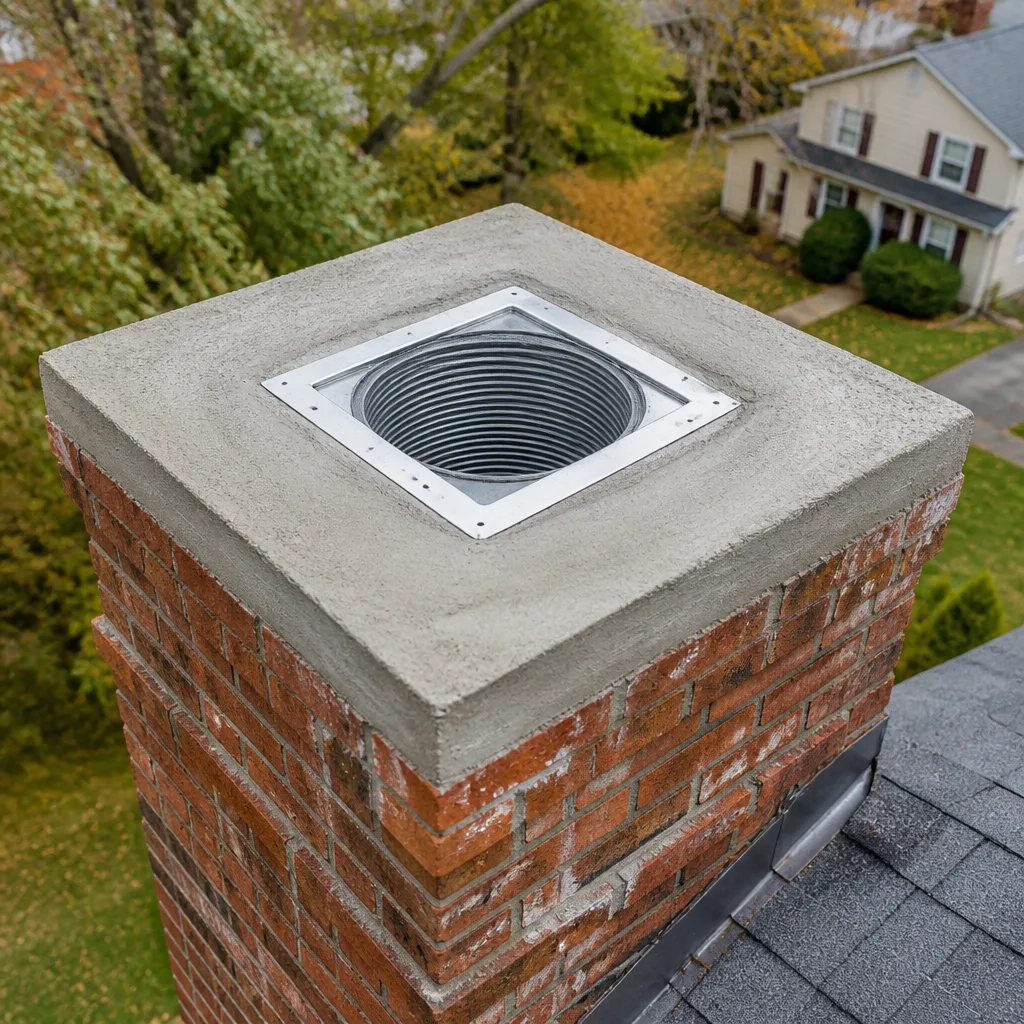
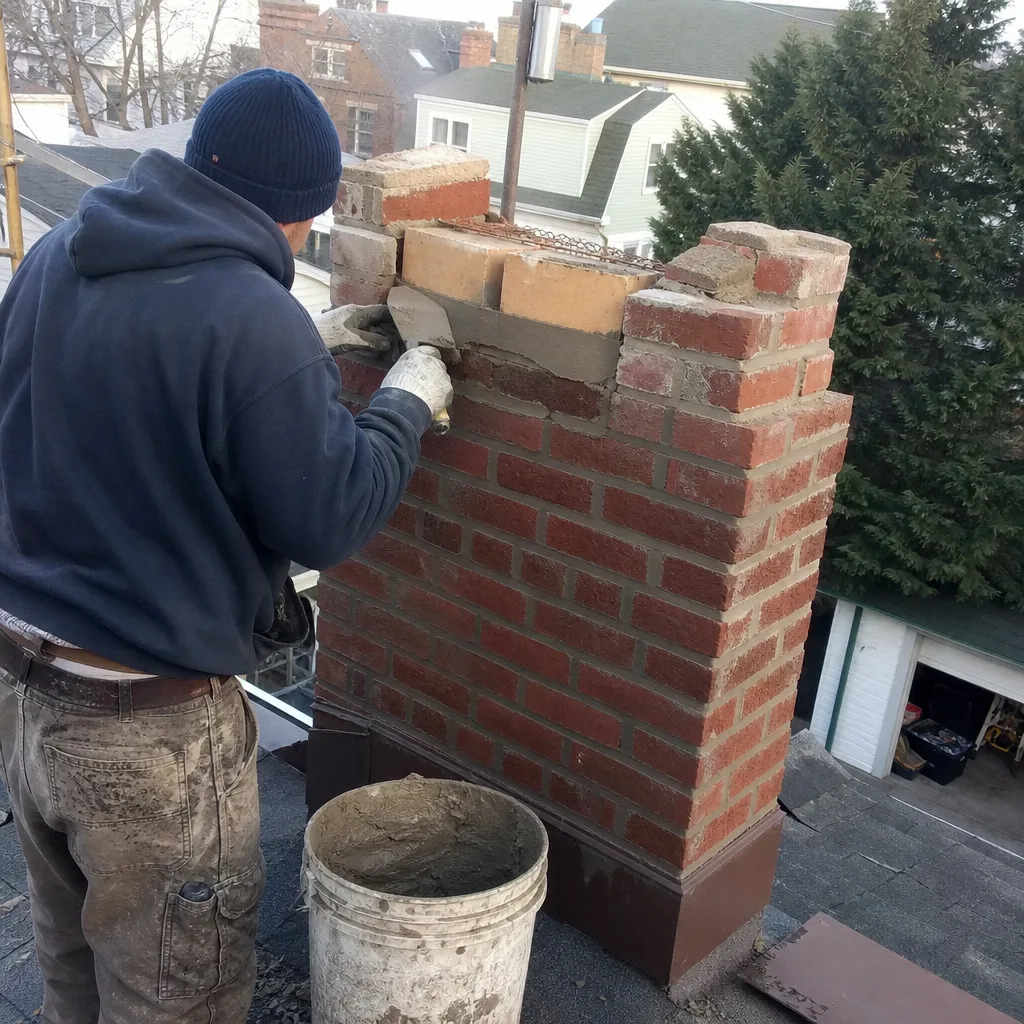
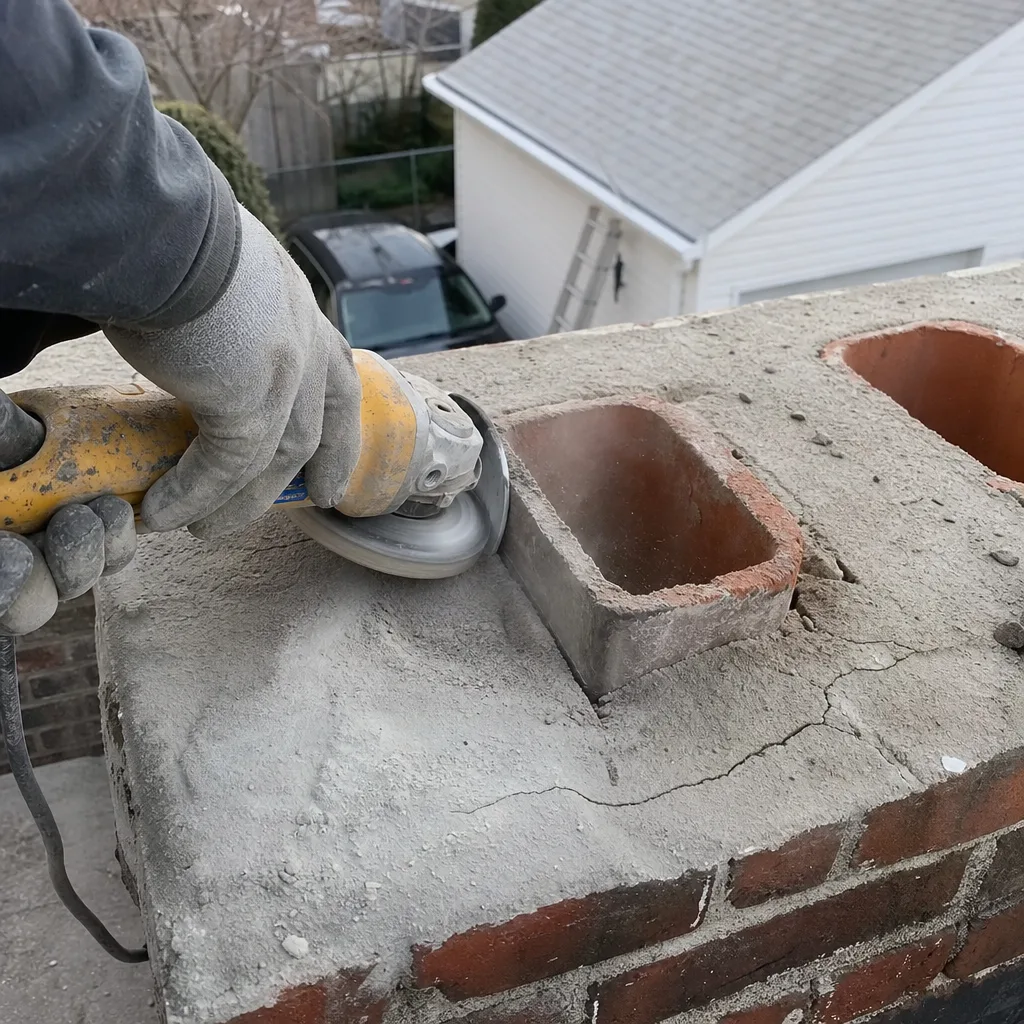
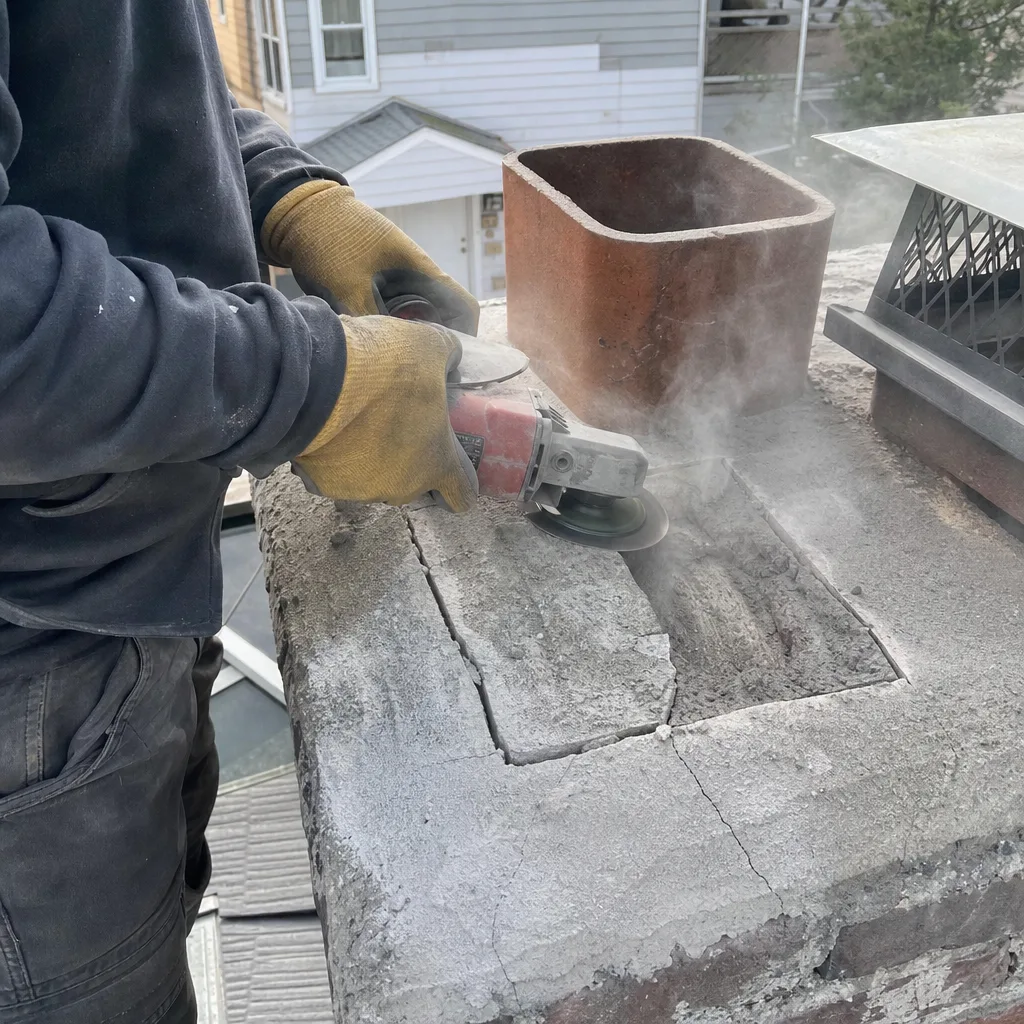
- Location: Efflorescence concentrated at the top of the chimney near the crown, visible from the street or from a rooftop view, suggests crown failure. The crown is the concrete cap that seals the top of the chimney from rain. When it cracks, water gets in at the top and migrates down.
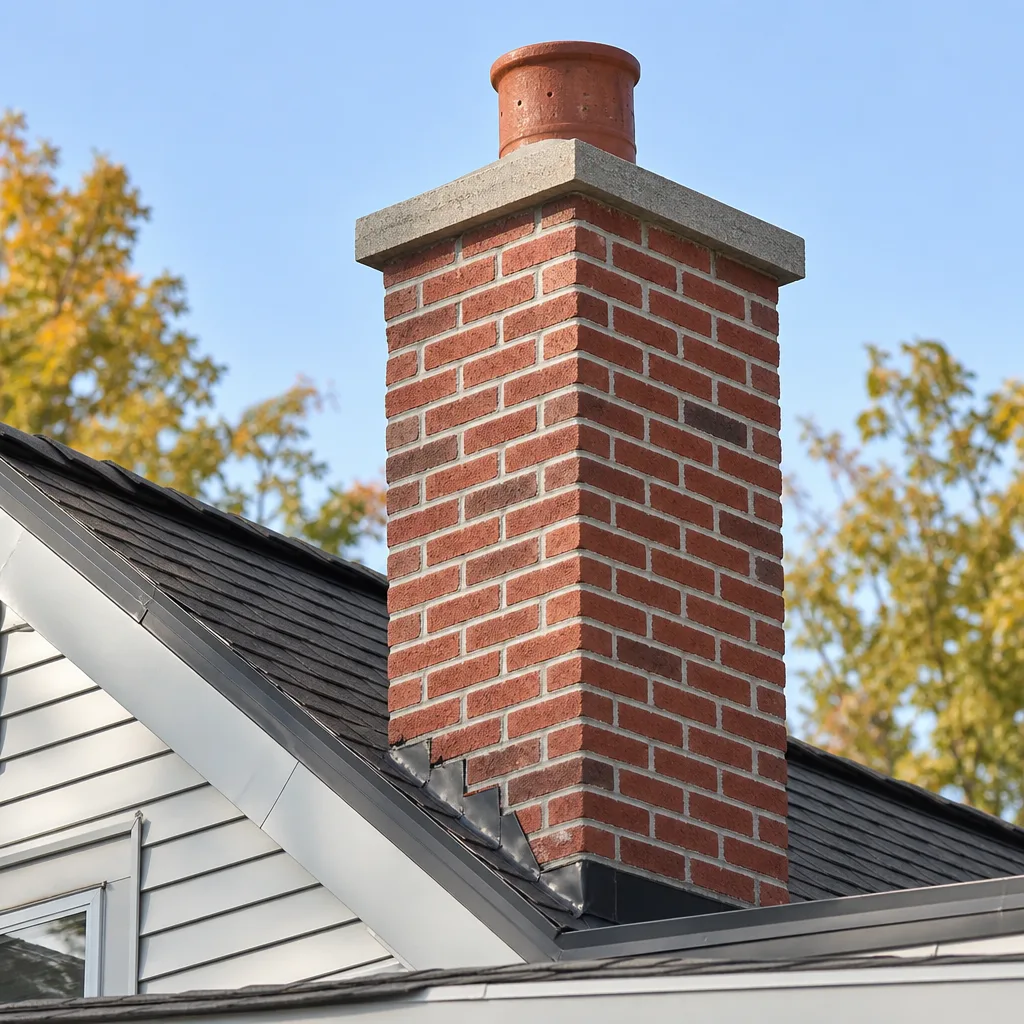
- Location: Efflorescence at mid-height, appearing as a white band, often indicates a failed flashing point where the chimney passes through the roofline. The flashing is the sheet metal that seals that junction, and when it fails, rainwater runs into the chase.
- Location: Efflorescence at the base, especially on an interior wall adjacent to the chimney, suggests water has been entering for long enough to saturate the masonry all the way down. This is an advanced condition.
If you share a party wall with a neighbor and either of you sees efflorescence on the chimney face, both flues should be inspected. The water is in the shared masonry, and the flue that’s allowing entry may not be the one whose wall is showing the salt deposits. This is common in the blocks between 21st Avenue and Astoria Boulevard where the housing stock dates to the 1920s and 1930s.
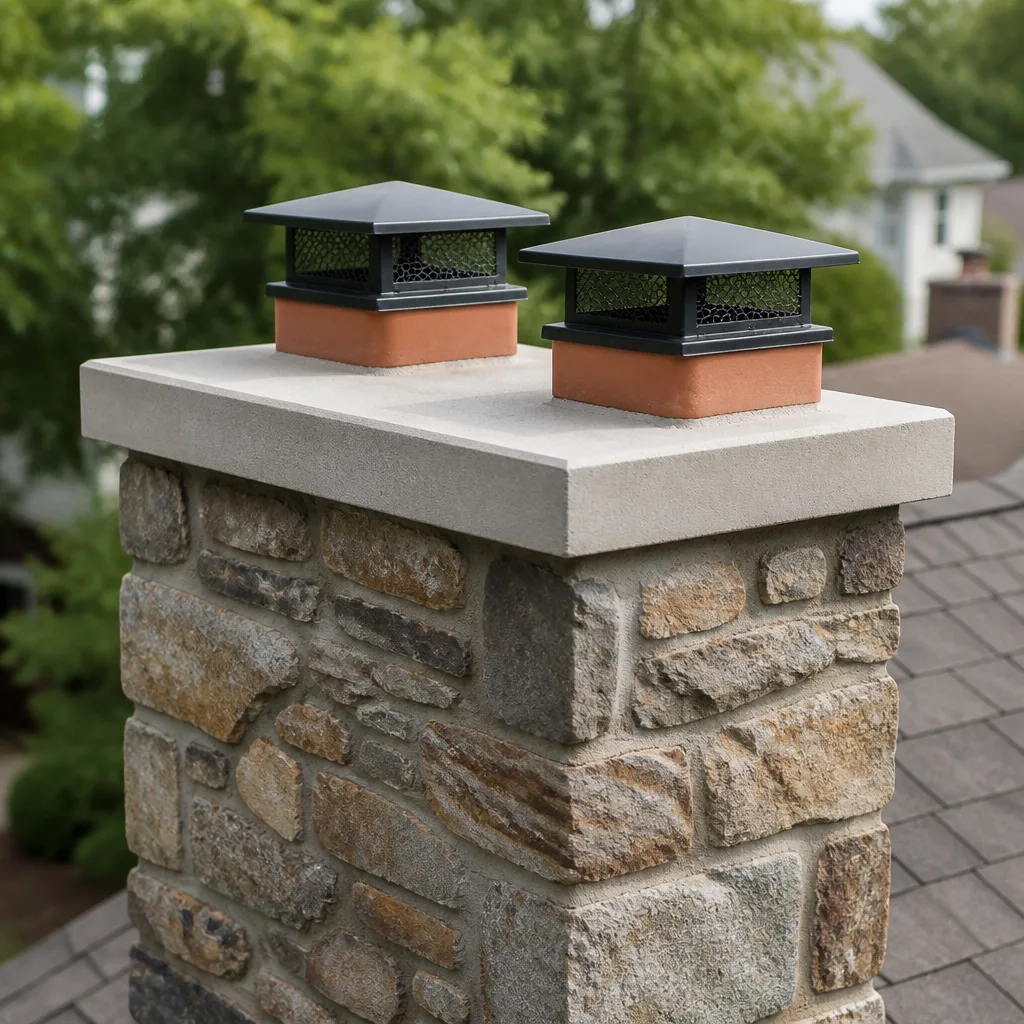
A camera scan will identify whether the water has entered the flue itself, and a Chimney Repair in Astoria evaluation will establish whether the crown, flashing, or mortar joints need work. Chimney caps from manufacturers like Copperfield are a standard first-line fix for crown-level water entry, but only after the extent of the damage is known.
Animal Debris at the Firebox: What It Means for Your Liner
Nesting material in the firebox, droppings at the damper, feathers, or the smell of decomposition are signs with two very different implications. The first is that an animal has built a nest inside the flue, and the chimney needs cleaning before the next fire. The second is that the animal gained entry through a gap that indicates a structural or cap failure, and the liner may have been affected.
Birds and squirrels are the most common occupants of Astoria chimneys. Raccoons use larger flues and will leave significant debris. Here’s how to interpret what you’re seeing:
- Small twigs, grass, and feathers clustered around the damper or visible at the top of the firebox: A bird or squirrel built a nest in the flue above the damper. The nest itself is a fire and draft hazard and must be removed before the chimney is used. But this finding is usually a cleaning issue, not a repair issue. The fix is removal plus a properly sized chimney cap to prevent re-entry.
- Debris in the firebox that includes plaster, mortar chips, or pieces of brick: This is not animal activity. This is the liner or interior masonry spalling, which means pieces of the flue wall are breaking loose and falling. This is an inspection-level finding and may be a do-not-use finding depending on the volume of debris. The camera scan will show where the material is coming from.
- Persistent animal presence year after year with no visible nest from the hearth: The animal may be entering through a gap in the crown or a missing flue cap that is out of sight from ground level. If the cap assembly is compromised, the flue interior is exposed to rain, and the repeated wet-dry cycling is accelerating liner damage.
One Astoria-specific consideration: the old masonry chimneys in this borough often have offset flues, meaning the flue shifts direction partway up the chase. An offset creates a ledge where debris, nesting material, and creosote accumulate and block the passage. In our experience with Astoria’s pre-war housing stock, off-set flues are common, and they change the cleaning scope because the offset must be cleared with different tools than a straight flue. If an animal has been entering through a damaged cap, the offset is often where the nest material piles up first.
Removal of animal debris is not a repair. But the inspection that accompanies removal is how you find out whether the entry point is a simple cap replacement or whether the animal spent enough time in the flue to damage it. We don’t guess at that. The camera shows it.
Gas Appliance Warning Signs Homeowners Blame on the Appliance
Gas fireplaces, gas inserts, and gas water heaters connected to a chimney produce warning signs that many Astoria homeowners attribute to the appliance itself, not the flue. When the flue is the problem, the appliance often shows it first, because it can’t maintain combustion without a functioning exhaust path.
Here are the three signs that should redirect your attention from the appliance to the chimney:
- Pilot instability: The pilot flame on a gas insert should stand steady and blue. If it flickers, lifts, or goes out repeatedly even after the thermocouple has been replaced, it may be reacting to air pressure changes in the flue. A blocked or partially collapsed flue changes the draft and causes the flame to flutter. Replacing the pilot assembly won’t fix the flue.
- Backdrafting odor: A gas insert or gas log set that smells of combustion gases, especially on cold still days, is backdrafting. The flue is not maintaining enough upward draft to clear the combustion byproducts, and they’re spilling into the room. This includes carbon monoxide, which is odorless and colorless, which means the smell you detect might be the trace compounds that accompany it, not the CO itself. Do not run the appliance until the flue is inspected.
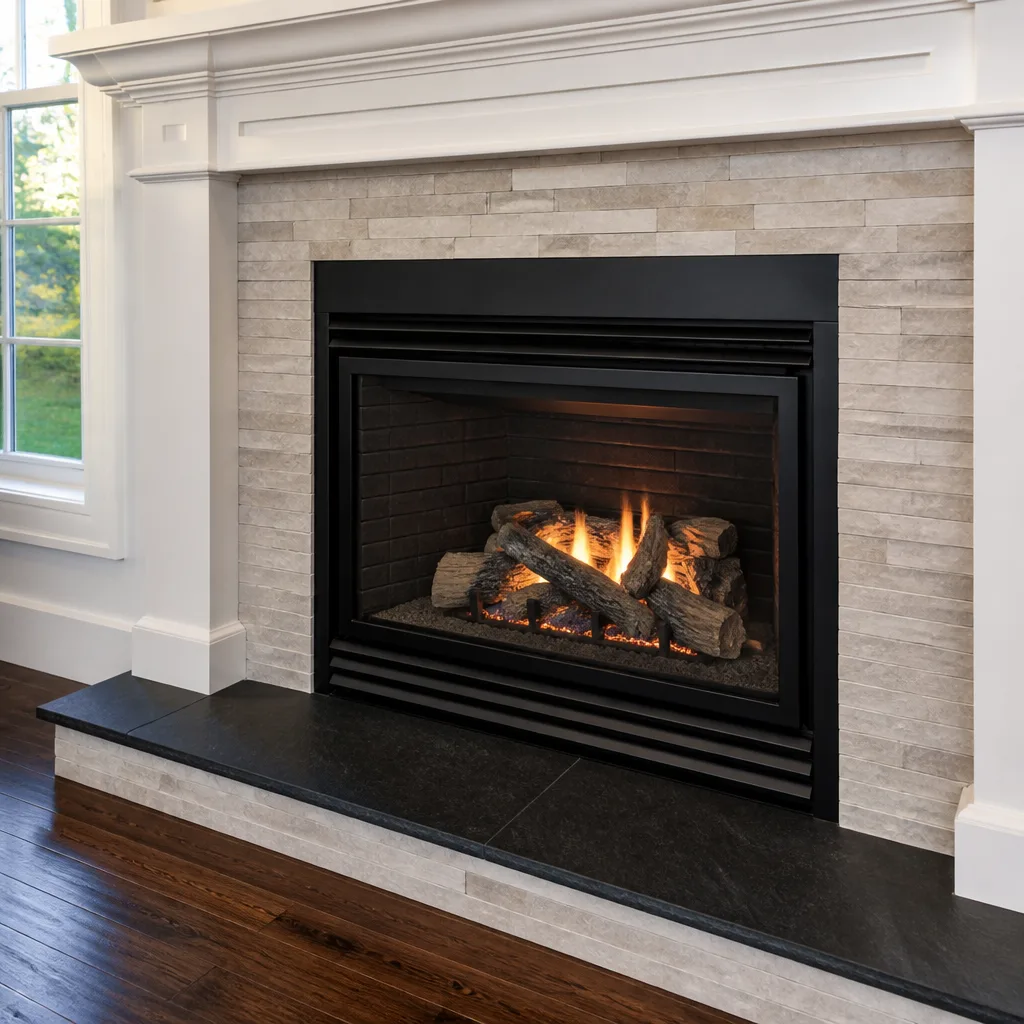
- Yellow or orange burner flame: A properly functioning gas appliance burns with a clean blue flame. Yellow or orange tips mean incomplete combustion, which produces more carbon monoxide. A dirty burner can cause this, but so can a flue that isn’t delivering enough oxygen to the fire, or a flue that’s leaking air into the system at the wrong point. The camera-documented inspection we perform as standard will tell you whether the flue interior is clean, properly sized, and structurally sound.
In Astoria, many of the older brick chimneys that were built for wood fireplaces now vent gas inserts or gas-fired boilers. The transition matters because gas flues operate at lower temperatures than wood flues. Lower temperature exhaust means more condensation, and condensation plus an unlined or clay-tile-lined flue means accelerated deterioration. If your house was built before the 1950s and the original masonry flue was not relined when the gas appliance was installed, the flue may be deteriorating in a way that a wood appliance would not have caused.
The fix is a liner sized for the gas appliance, often a stainless steel system from Famco or DuraFlex. But the first step is seeing the flue as it is now, not as the original builder intended it.
Odd Sounds, Draft Changes, and the Damper You Never See
Some warning signs are not visual or olfactory. They’re auditory or pressure-based, and they’re easy to misattribute to the house rather than the chimney.
- Rustling, scratching, or flapping sounds inside the chimney: These are animals, not the house settling. The sound may be intermittent and often at dawn or dusk. It tells you the chimney is open to wildlife entry, which also means it’s open to rain and debris. A cleaning plus a cap resolves the immediate issue. The camera scan confirms whether the animal caused damage to the liner while it was inside.
- A change in draft behavior between seasons or between fires: If the fireplace used to draw well and now sends smoke into the room under conditions that never used to bother it, something has changed in the flue. Creosote accumulation is the most common cause, followed by nesting material, a partially collapsed liner, or a chimney cap that’s been displaced. A cleaning resolves the first. The camera determines whether the other possibilities are in play.
- Clinking or what sounds like rain inside the chimney when it’s not raining: That’s often debris, including spalled liner material, settling. A tile liner that has cracked can release pieces that fall into the smoke shelf or the offset. When the wind moves through the flue, the loose pieces shift audibly. This is an inspection-level sign.
- Whistling or moaning when the wind blows: This indicates a changed opening geometry, often from a shifted cap or a partially blocked flue. If the sound is new, the configuration has changed, and the cause deserves a camera look.
And then there’s the damper. Most Astoria homeowners know where their damper is and can operate it by feel. What they don’t know is what’s above it. The damper is not a seal, and a closed damper is not a containment system. If you close the damper and still smell smoke in the house, or if you close it and cold air continues to pour down the chimney, the flue above is compromised. A chimney that can’t be sealed at the damper during winter is a chimney that has a problem the damper can’t fix.
Common Mistakes to Avoid
- Burning a “chimney cleaning log” and calling it a cleaning. Creosote-sweeping logs can loosen light Class I soot, but they cannot remove Class II or III creosote, and they cannot tell you whether the liner is cracked. In our experience in Astoria, they give homeowners a false sense of completion. A cleaning log is not an inspection and not a substitute for one.
- Using the fireplace again after a camera scan was deferred. If you had a chimney inspection scheduled and canceled it because the smell went away, you’ve mistaken weather for resolution. The smell going away means conditions changed, not that the flue healed.
- Assuming a shared wall means a shared problem can be ignored. In Astoria rowhomes, a neighbor’s chimney fire can damage your flue through the shared masonry. If you know or suspect a neighboring unit had a chimney issue, your flue deserves a camera look. The fire doesn’t respect the property line.
- Recaulking the firebox or hearth to stop a smell. A smoke smell is not a caulking problem. Sealing the firebox keeps gas from entering the room through the gap, but it does not stop gas from moving into the wall cavity elsewhere. You’ve contained the symptom, not the cause, and the gas is still moving through your house.
- Ignoring a gas appliance warning because the appliance is “fairly new.” A gas insert installed in 2020 can be vented into a 100-year-old masonry flue. The flue’s condition has nothing to do with the insert’s age. The pilot is flickering for a reason, and the reason is above the appliance.
- Believing that a chimney cap is decorative. A cap is the difference between a dry flue and a wet one, between a clean flue and a racoon nursery, between a draft that works and a downdraft that pushes smoke into the living room. We install caps from Copperfield and Olympia Chimney on most Astoria chimneys because the local conditions demand them.
- Waiting for the “right season” to get the chimney looked at. In Astoria, the right season for a Fireplace Services in Astoria visit is late summer or early fall, before the first fire. But if you’re seeing warning signs, the right season is now. The chimney doesn’t know what month it is. A problem that’s visible in July will be worse in November.
When to Call a Professional
If you see any of the do-not-use signs we’ve described, stop using the chimney and call. That list includes tar-like smell at the hearth, smoke entering the room during normal operation, pilot instability or yellow flames on a gas appliance, and visible debris falling from the flue into the firebox.
If you see inspection-level signs, including summer smoke smell that persists on calm days, efflorescence on the chimney brick, animal activity inside the chimney, or sounds that indicate loose material in the flue, book an Chimney Repair in Astoria evaluation that includes a camera scan. If you see cleaning-level signs, like flaky dark buildup above the damper or a mild smoke smell draft issue, a standard Chimney Cleaning & Sweep in Astoria is the right call.
Level Two Chimney Astoria offers free estimates in Astoria. Call (516) 301-1549 and we’ll give you a written price before any work starts, with a camera-documented inspection included on every visit.
Frequently Asked Questions
A chimney cleaning and camera inspection in Astoria typically costs $200 to $450 depending on flue type, creosote class, and access conditions. The price is given in writing before work starts, so you’ll know the total before we arrive. Call (516) 301-1549 for a written quote based on your chimney’s specifics.
The Chimney Safety Institute of America recommends a cleaning after every cord of wood burned or at least once per year, whichever comes first. In Astoria’s older masonry chimneys, where moisture interacts with creosote and accelerates buildup, we lean toward annual maintenance even for light users. If you’re burning regularly from October through March, once a season is the practical minimum.
You need a new liner only if the camera scan shows cracks, gaps, spalling, or size incompatibility that cannot be repaired. If the existing tile liner is intact and properly sized, you don’t need a new one, and we’ll tell you that. Liners we install from HeatShield or DuraFlex come with a written warranty, and the recommendation is based on images you see.
Creosote accumulates, the flue narrows, draft worsens, and the fuel load in the flue keeps rising. A chimney fire can ignite that creosote, and a chimney fire can crack the liner, melt roofing materials near the chase, and spread to the house. There is no scenario where skipping cleaning makes the chimney safer. Call (516) 301-1549 to check where your flue stands.
A visual check from the hearth cannot see the middle of the flue, and the middle is where most liners fail. The camera goes where the flashlight can’t. At Level Two Chimney Astoria, we’ve been running camera-scan documentation as standard since 2009 under Clause 4 of the Haven Standard, and we’ve caught liner failures that a visual check would have missed entirely.
You can brush a straight flue from above if you have safe roof access and the right equipment, but you cannot see the result, and you cannot assess whether the liner is intact while you’re doing it. For a masonry chimney in a Astoria rowhouse, the access is often steep, the flue is offset, and the relationship between the cleaning and the inspection is the point. We recommend a professional sweep with camera documentation for the first visit, then you’ll know whether your particular chimney lends itself to any DIY maintenance.
The Bottom Line
Chimney warning signs fall into three classes, and the most dangerous ones are not the most dramatic. A summer smoke smell, white dust on brick, or a flickering pilot flame can indicate a flue that is already compromised, and the cost of misreading those signs is not measured in cleaning fees. It’s measured in fire and carbon monoxide risk. Astoria’s housing stock makes this more acute than average: shared chases, aging tile liners, and moisture from the coastal climate all accelerate the deterioration that warning signs reveal. The fix is not to guess. The fix is to look, with a camera, and to get the answer in writing before anyone touches the chimney.
Written by Corrine Halstead, Owner at Level Two Chimney Astoria, serving Astoria since 2009.